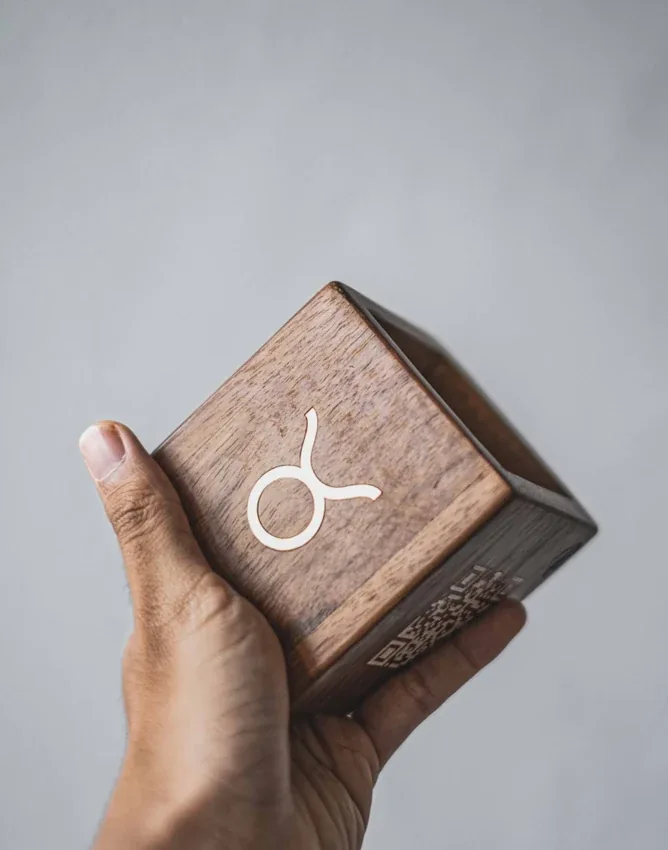
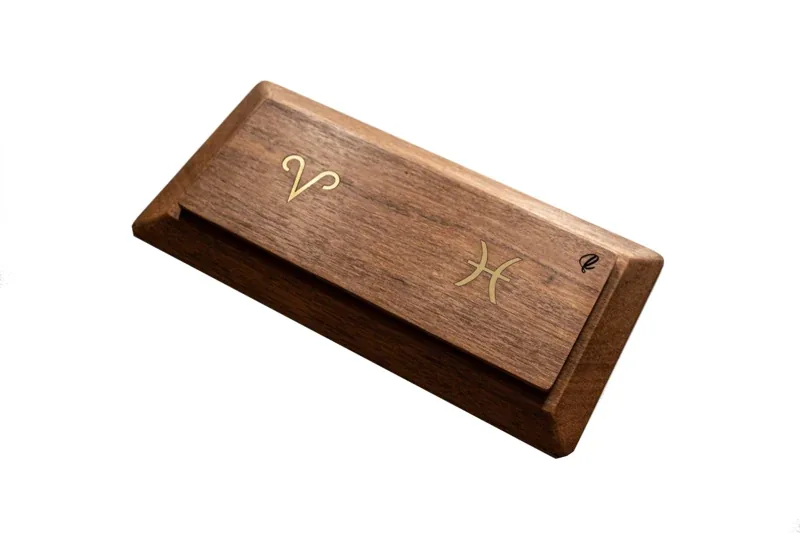
Some branding is designed to be noticed immediately. Brass inlay works differently. It catches the light, rewards a closer look and gives a logo or symbol a physical presence without covering the character of the wood.
On reclaimed wood, that contrast is especially expressive. The timber brings grain, age and natural variation. Brass introduces a precise line and a warm metallic accent. Together, they can create a custom object that feels considered rather than promotional.
At i-REWOOD, brass details are one of several possible directions for personalisation. They are not suitable for every drawing or every object, so each request is reviewed for feasibility, scale, material and production requirements before a sample is prepared.
Why brass and reclaimed wood work together
Brass and wood age in different ways, yet they share a visual warmth. Brass can move from a bright golden tone towards a softer patina, while reclaimed timber already carries tonal variation and marks from its previous life.
The pairing can feel contemporary without appearing cold. A clean brass detail may sharpen the form of a wooden tray, holder, box or hospitality accessory. At the same time, the grain prevents the object from feeling overly manufactured.
This balance is useful in interiors where natural and architectural materials meet. In Bali, reclaimed wood often sits comfortably beside stone, plaster, linen, ceramic and metal. A small brass accent can connect a custom object to the wider design language of a hotel, villa, restaurant, spa or retail space.
A detail should support the object
The strongest inlay is not necessarily the largest one. A brass mark works best when its position, proportion and level of contrast support the object’s purpose.
On a pen holder, the mark should remain visible without competing with what the holder contains. On a tray, it may sit near an edge or within a dedicated area. On a presentation box, it can act as a quiet focal point when the lid is closed.
The object still needs to function. Edges must remain comfortable, surfaces practical and the composition balanced. Branding should not make cleaning difficult or introduce a detail that feels vulnerable in everyday handling.
That is why personalisation needs to be considered during development, not added as an afterthought. The available surface, thickness of the wood, grain direction and intended use all influence what is possible.
Begin with the reclaimed material
Reclaimed wood is not a perfectly uniform sheet. Every usable piece has its own grain, colour and history. Old cuts, holes, weathering or tonal changes may influence how a section is selected for a new object.
One of the principal materials used by i-REWOOD is reclaimed Ulin, also known as Borneo ironwood. It is a dense hardwood associated with durable applications. Reusing recovered Ulin allows an existing material to enter a new chapter at a smaller, more personal scale.
That density and character can be an advantage, but it also means the design must respect the material. Not every recovered board has the same dimensions. Not every section is appropriate for a fine detail. Selection and preparation are therefore part of the project.
Read more about reclaimed Ulin in Bali’s tropical climate and the journey from Kalimantan to the Bali workshop.
Designing a mark for brass inlay
A logo created for print or a screen may need adjustment before it can become a physical metal detail. Very thin lines, tiny gaps and complex lettering can lose clarity when reduced.
The first step is to identify the essential part of the identity. Sometimes the full company name is appropriate. In other cases, a monogram, symbol or simplified emblem creates a stronger result.
Scale is equally important. A mark should have enough space to read clearly while leaving room for the reclaimed wood to remain visible. The surrounding grain is part of the composition, not empty background.
Artwork should be supplied in the clearest format available, ideally as vector artwork when possible. The workshop can then assess dimensions, line thickness and placement. If simplification is needed, it should be agreed before sampling.
Brass details for hospitality projects
Hospitality objects are handled repeatedly. A reception accessory may be used every day. A room tray is cleaned and reset between guests. A restaurant or spa object becomes part of an operational routine, not only part of a photograph.
For that reason, a brass detail should be evaluated in context. Will the object encounter water? How will staff clean it? Is the mark placed where items may scrape across it? Does the finish suit the maintenance routine?
A sample allows the hospitality team to consider these questions before production. It also shows how the object relates to existing materials, signage and brand colours within the space.
Used with restraint, brass can create continuity across different custom wooden objects. A related mark or metallic accent may appear on a welcome tray, holder, room accessory or gift while each object keeps its own function.
White label and corporate gifting
For white-label collections, a brass detail can help connect an i-REWOOD object to another brand universe. The object may begin from an existing form or be developed around a specific brief, quantity and presentation.
Corporate gifts can use the same principle. Instead of placing a large printed logo on a generic item, the identity becomes a considered material feature. The gift remains useful and recognisable without feeling like disposable merchandise.
The choice depends on the recipient and occasion. A small emblem may suit an executive gift. A hotel opening may call for a date or project symbol. A retail collaboration may require a consistent brand mark across a family of objects.
Explore the available starting points on our B2B & White Label page.
From concept to sample
A custom brass-and-wood project should begin with a concise brief. Explain the object, its function, approximate dimensions, required quantity, target date and delivery destination. Include the artwork and references for placement or finish.
The feasibility review considers the relationship between the design and the available reclaimed material. Dimensions may need adjustment. A complex mark may need simplification. The chosen object may offer a better position for the detail than the one first imagined.
Once a workable direction is agreed, a sample can test the physical result. This is the moment to evaluate scale, legibility, alignment, surface finish, weight and the overall feeling of the piece.
A digital mock-up is helpful, but it cannot fully show how brass responds to light or how natural grain passes around the mark. The sample connects the visual idea with the real material.
Precision and natural variation can coexist
Brass introduces a precise element, while reclaimed wood remains naturally varied. A successful series allows both qualities to exist.
The position and dimensions of the mark can remain consistent across production. Grain and colour may still change from one object to another. These variations should be discussed and included in the quality expectations for the project.
Some clients prefer close visual matching. Others welcome stronger differences because they make each object feel individual. Neither direction is automatically correct. The important point is to establish the intended level of variation before production.
Finish, touch and long-term care
The wood finish affects colour, texture and maintenance. It can also change the visual contrast with the brass. A darker or richer timber tone may make the metal more prominent, while a lighter natural finish creates a softer relationship.
The correct finish depends on use. A decorative object, hotel accessory and food-contact piece have different requirements. Cleaning methods, exposure to moisture and frequency of handling should all be shared during development.
Brass can naturally change in appearance over time. Some projects may welcome that evolving patina; others may prefer a more consistent polished look. Expectations for care should be agreed so the object can age in the intended way.
What to include in your project enquiry
To help evaluate a brass inlay project, prepare:
- the object or function you need;
- approximate dimensions and quantity;
- the logo, symbol or lettering to reproduce;
- your preferred placement and visual references;
- the environment and daily use of the object;
- the desired finish, delivery location and target date.
If the design is still developing, a sketch or reference image is enough to begin the conversation. The next step is to determine what works with the material and workshop process.
A quiet signature in wood and metal
Brass inlay does not need to dominate a custom object. Its strength lies in the relationship between precision and natural character.
The reclaimed wood carries signs of an earlier life. The brass brings a new identity. Crafted together in Bali, they create an object that can belong to a brand, a place or a particular moment without losing the material story beneath it.
For i-REWOOD, that is the purpose of a considered detail: not simply to display a logo, but to give it a place within the object.